
The Moment the Engine Turned On
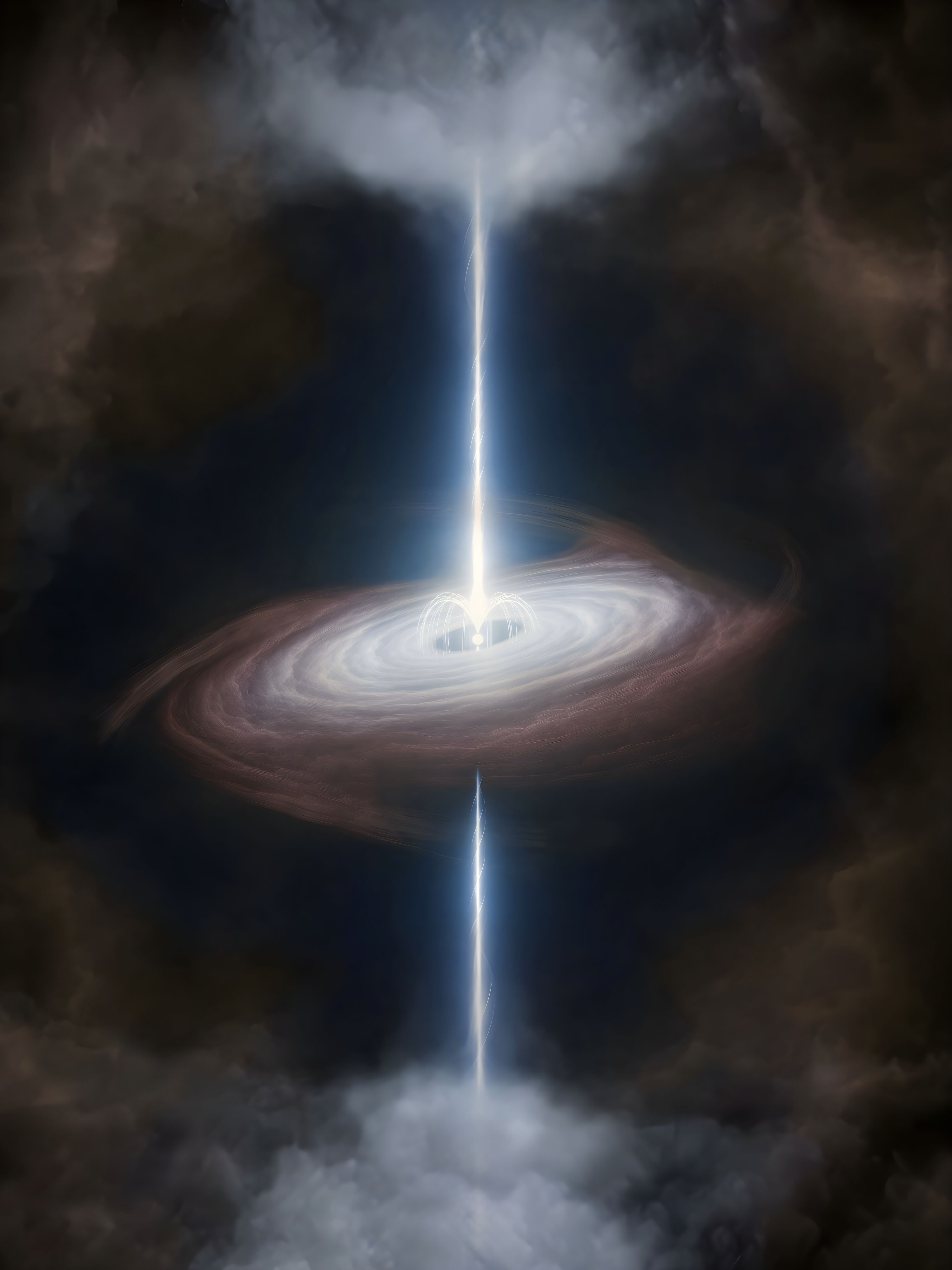
A newborn magnetar (a highly magnetized, rapidly spinning neutron star) powers the brightest supernovae in the universe from within. A disk swirling around it shapes the explosion and produces a detectable “chirp,” revealing gravity and extreme physics at work for the first time as a star dies.
A rapidly rotating magnetar sits in the center of an expanding supernova ejecta. Massive amounts of energy from the magnetar are deposited into the ejecta, causing it to glow ten times brighter than an ordinary supernova. An accretion disk, suspended on the magnetic field of the magnetar, precesses due to frame-dragging, an effect predicted by Einstein’s theory of relativity but never seen in a supernova. The precession causes the energy deposition to oscillate with time, resulting in the unprecedented “chirp” in the supernova light curve we report on in our paper, accepted in Nature.
This art does not use generative AI. The visualization was produced in Blender, and rendered in Cycles. Post-processing was done in ProCreate with help from Curtis McCully.
