
Patterns in Cake
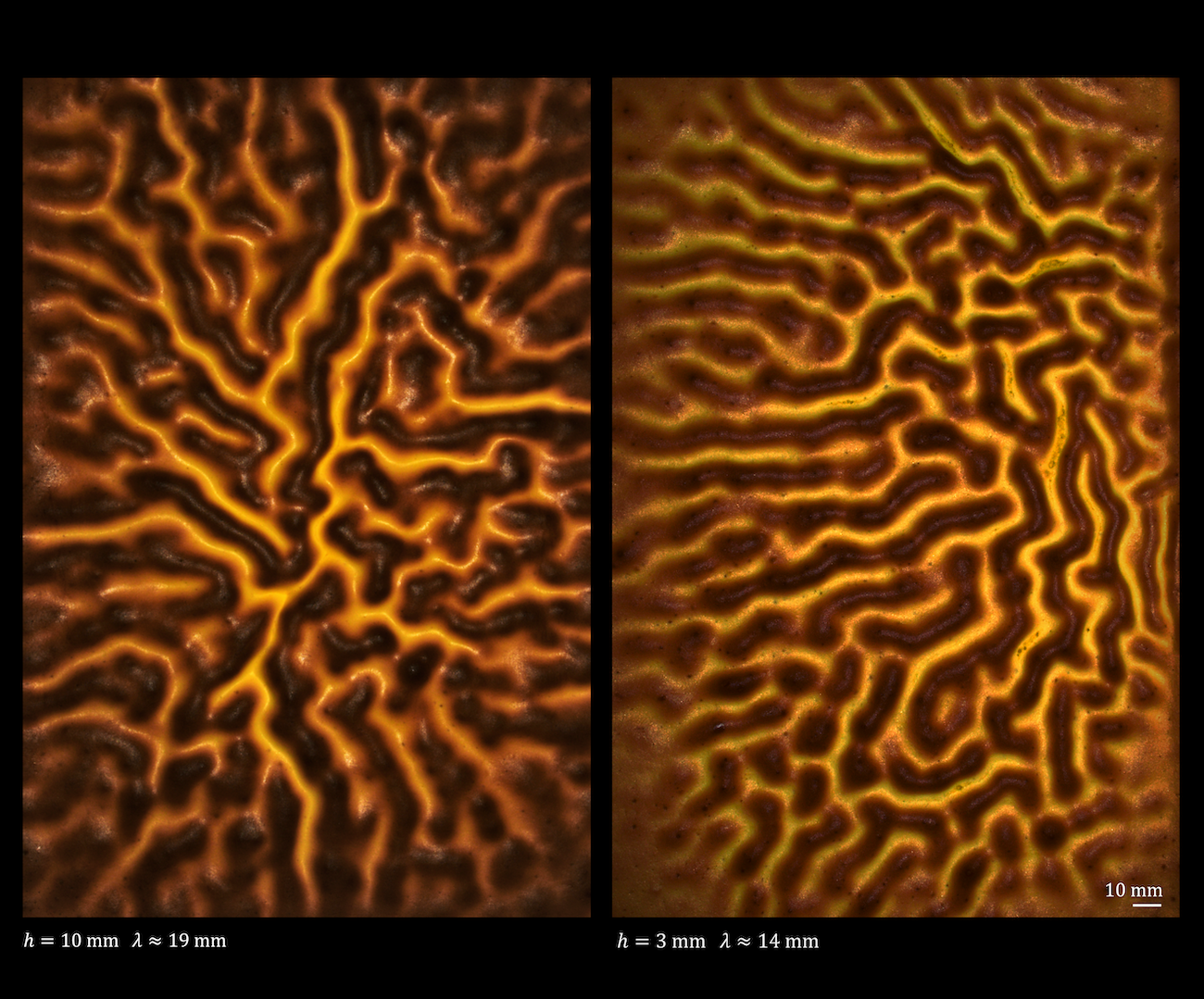
As the Tiger skin cake bakes, a solid layer forms atop the raw batter and expands until it has to accommodate that growth. It does so by shaping itself into these intricate wrinkled landscapes, reminiscent of the brain or lava flows. The larger the batter thickness, the larger the patterns will be.
While cake baking is a science in and of itself, what we are trying to understand is the mechanism through which the patterns form, not only specific to the cake. When there is a mismatch in the growth rate of two layers, one of the ways the system can adapt is by wrinkling, much like our skin wrinkles as we age. Wrinkling also occurs when a stiff film, sitting on top of a soft substrate or a viscous fluid, gets compressed. Instead of simply bulging out (think of a sheet of paper when you push on its sides), the constraint leads to this sinusoidal pattern. Hence, the spacing of the browned peaks gives the pattern wavelength, which helps quantify the effect of changing the cake’s characteristics, such as the batter thickness or baking temperature.
